Table of contents
How does botanical knowledge survive the death of a healer, the closure of an herbarium, or the slow erosion of a language? From Indigenous pharmacopeias to monastery gardens and colonial-era field notes, plant wisdom has always depended on something deceptively simple: documentation, because what is not recorded is easily distorted, commodified, or lost. Today, with biodiversity under pressure and health misinformation spreading fast, the way researchers, communities, and institutions document botanical knowledge is no longer an academic concern, it is a matter of cultural continuity and scientific credibility.
When notes decide what survives
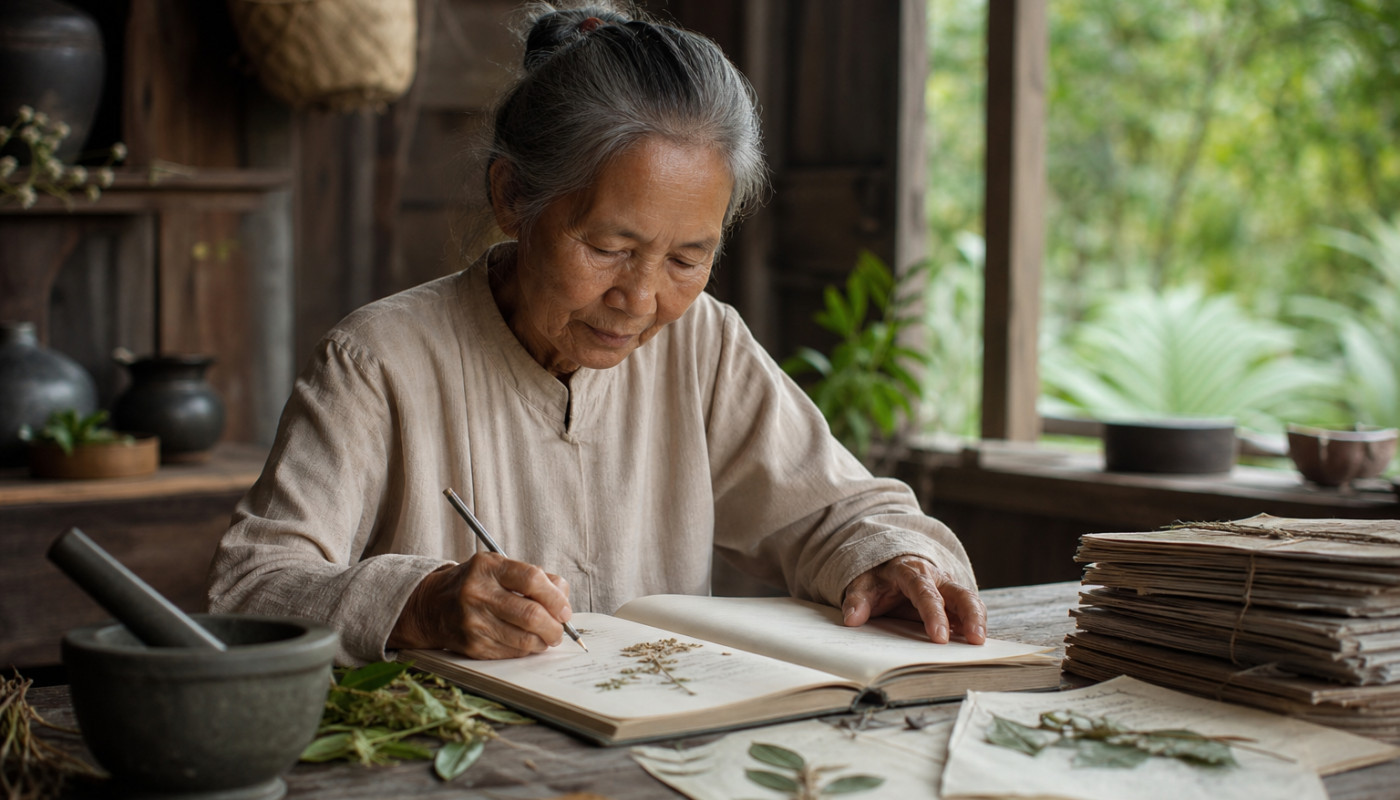
What gets written down, and what vanishes? That question sits at the heart of how botanical wisdom is preserved, because documentation is not merely a passive archive, it is an active filter that shapes what later generations believe to be true. Historically, many of the world’s best-known medicinal plants entered formal science through notebooks: European herbals of the 16th and 17th centuries standardized descriptions and uses, while later, colonial expeditions produced thousands of specimens and field observations that still anchor modern taxonomy. The Royal Botanic Gardens, Kew, for example, has described its Herbarium as holding around seven million preserved plant specimens, a scale that illustrates how written labels, collection dates, and locality data become scientific infrastructure rather than administrative detail.
Yet documentation has also been the place where errors, exaggerations, and cultural misunderstandings harden into “facts”. Ethnobotany has long wrestled with this problem: plant uses are frequently context-dependent, linked to preparation methods, dosage, seasonality, and contraindications that are difficult to compress into a line of text. When those nuances are stripped away, later readers may assume equivalence between a traditional infusion and an industrial extract, even though pharmacology can change dramatically with concentration and processing. The World Health Organization has estimated that a large share of people worldwide rely on traditional medicine for primary health needs, a reminder that documentation affects not only heritage but also public health, because poorly recorded practices can be misapplied, and well-recorded practices can be evaluated, safeguarded, and, where appropriate, integrated responsibly.
Modern science has begun to quantify why details matter. Reproducibility in natural products research often hinges on provenance data: where a plant was collected, how it was identified, and what part was used. A misidentified specimen can derail an entire line of inquiry, and because many genera contain closely related species with different chemical profiles, accurate vouchers and clear metadata are essential. In this sense, documentation is the quiet backbone of discovery, allowing a claim about an anti-inflammatory compound, for example, to be traced back to a plant, a place, and a method, rather than floating as an unattributable assertion in the literature.
Digital archives are rewriting ethnobotany
The paper notebook is no longer enough. Botanical documentation is rapidly becoming digital, networked, and searchable, and that shift is changing who can access knowledge, how quickly it travels, and how easily it can be scrutinized. Global Biodiversity Information Facility (GBIF), one of the largest open biodiversity data infrastructures, aggregates occurrence records from museums, herbaria, and research projects, and it now serves billions of records across taxa, with plants representing a substantial share. For botanical researchers, that scale makes it possible to map distributions, detect gaps in sampling, and model climate-driven range shifts with a precision that would have been unimaginable a generation ago.
But ethnobotanical wisdom is not just distribution points on a map, it is stories, vernacular names, preparation techniques, and culturally embedded rules of use, and digital systems are struggling to represent that richness without flattening it. Good digital documentation therefore demands careful structure: multilingual fields, audio recordings for pronunciation, geospatial sensitivity settings for sacred or vulnerable sites, and clear attribution to knowledge holders. Increasingly, projects also lean on controlled vocabularies and taxonomic backbones to reduce ambiguity, because one local name may refer to multiple species, and one species may have dozens of local names. The promise of digital archiving is reach, but its risk is oversimplification, and journalists, editors, and curators are learning that the interface can silently reshape the meaning of what is preserved.
The acceleration of AI tools is adding another layer, because automation can help transcribe field interviews, translate notes, and extract entities such as plant parts, symptoms, and preparation types from large corpora. This can be transformative for over-stretched institutions, especially smaller herbaria and community archives that sit on decades of material with limited staff time. For teams exploring such workflows, resources on AI assistants are increasingly part of the documentation toolkit, and some practitioners begin with practical overviews found by clicking here, before adapting tools to the ethical and technical constraints of sensitive knowledge.
Still, digitization does not automatically mean preservation. File formats become obsolete, servers fail, and poorly managed databases can be as fragile as damp paper. Long-term stewardship requires redundancy, persistent identifiers, and policies on access and consent, and it also requires funding, which is often the most precarious ingredient. The paradox is clear: the world is generating more botanical documentation than ever, yet without robust governance, the most valuable records can remain scattered, unsearchable, or vulnerable to misuse.
Who owns plant knowledge, and why it matters
Documentation can protect, and it can expose. Many communities have watched medicinal knowledge extracted from their territories, repackaged into commercial products, and returned as expensive supplements with little or no benefit-sharing. That history is why the politics of documenting botanical wisdom has become inseparable from questions of rights and ownership, and why international frameworks matter. The Nagoya Protocol, linked to the Convention on Biological Diversity, aims to ensure access and benefit-sharing for genetic resources, and it has sharpened attention on prior informed consent and mutually agreed terms, not only for physical samples but also for associated traditional knowledge.
In practice, the boundaries are messy. A plant may be widespread across borders, while the knowledge of its use is localized, guarded, or linked to specific rites. Documenting that knowledge in a public database can inadvertently enable appropriation, even if the intention is preservation. As a result, some archives now incorporate tiered access, delayed publication, or community-controlled repositories, where knowledge holders decide what can be shared, with whom, and under what conditions. This approach can be more time-consuming, but it reflects a growing consensus that ethical documentation is not simply a matter of citing sources, it is a matter of governance and reciprocity.
There is also a tension between scientific openness and cultural safety. Researchers may argue that open data accelerates conservation and drug discovery, and there is evidence that shared biodiversity data supports better environmental decision-making. Yet communities may reasonably fear that openness turns living heritage into extractable “content”. Good documentation therefore needs more than technical standards, it needs relationships, contracts, and sometimes the humility to leave certain things undocumented in the public domain. The most responsible projects are increasingly explicit about this, stating what was collected, what was not, and why.
Even language is part of ownership. Vernacular plant names encode ecological observation, migration histories, and metaphors that do not translate cleanly, and when those names disappear, so does a way of seeing the landscape. Documentation that includes original languages, speaker identities where consented, and contextual explanations can slow that erosion. Done well, it also complicates simplistic narratives that treat traditional medicine as a monolith, instead revealing highly specific local systems of classification, diagnosis, and practice.
From herbarium labels to climate resilience
Old specimens are gaining new urgency. Herbarium sheets collected a century ago were once viewed mainly as taxonomic references, yet they are now used to answer contemporary questions about climate change, invasive species, and shifting flowering times. Researchers have used dated herbarium specimens to track phenological change, because a pressed plant with a collection date can reveal when a species flowered or fruited in a given year, and repeated across thousands of records, these data show trends that align with warming temperatures. In other words, a label written in the field can become climate evidence generations later.
Botanical wisdom also supports resilience at the community level, especially in regions where climate stress is reshaping agriculture and health. Documentation of drought-tolerant wild foods, flood-resistant medicinal plants, or traditional pest management can inform adaptation strategies, provided it is recorded with enough specificity to be actionable. This is where journalism, science communication, and documentation intersect: it is not enough to say a plant is “used for fever”, readers and practitioners need preparation details, safety cautions, and an understanding of what evidence exists, whether it is clinical, pharmacological, or experiential. Responsible documentation is, in that sense, anti-sensational, because it favors clarity over miracle claims.
There is also a conservation dimension. The International Union for Conservation of Nature (IUCN) Red List has repeatedly highlighted risks to plant diversity, and while not all species have been assessed, the direction is clear: habitat loss, overharvesting, and climate change threaten botanical resources, including those central to traditional medicine. Documentation can support conservation priorities by identifying culturally significant species, harvesting pressures, and substitution patterns, information that is often invisible in purely ecological datasets. When knowledge holders report that a once-common plant is now hard to find, that observation can be an early warning signal, but only if it is captured, verified, and connected to decision-making.
Ultimately, preserving botanical wisdom is not nostalgia, it is capacity. It helps scientists replicate results, helps communities defend and transmit heritage, and helps societies navigate a century where both ecosystems and information systems are under strain. The work is painstaking, often underfunded, and sometimes politically fraught, yet it remains one of the most practical investments in continuity we can make.
What readers can do, concretely
If you want to support the preservation of botanical knowledge, start locally and plan realistically. Visit a botanical garden or herbarium open day, and ask how collections are funded; small donations and memberships often matter more than grand gestures. For personal projects, set a budget for proper recording tools, and prioritize consent forms, audio backups, and clear taxonomy sources.
If you are documenting family or community remedies, consider partnering with a local museum, library, or university that can offer long-term storage, and ask about grants or cultural heritage programs that may subsidize archiving costs. When in doubt, record less publicly, store more securely, and let knowledge holders set the terms.
Similar

What are the main features of ChatbotGPT ?

4 steps to secure your web hosting

The Best Kitchen Utensils In 2021

Virtual Reality: The Global Market Forecast And Growth Potential
